
Somerset Wivenhoe Fish Stocking Assn
Making a Better Fishery Future
History Of Brisbane River Cod
MURRAY COD
Daily Mail – Brisbane. 19 Nov 1925
MURRAY COD
(To the Editor.)
Sir,— In a recent Issue of a Sydney weekly an article appeared relative to the Murray cod (“Oligorus magusruntis”) deploring the gradual extinction of this, the most excellent of fresh water food fish on the globe. The fish of half a hundredweight Is now taken In the many tributaries of the Murray River. Even the smaller fish are becoming gradually scarcer.
The same applies to our rivers more so, in fact: especially those rivers that- have their exit on the east coast -such as the Brisbane,
Logan, Albert, and Mary, and many creeks flowing into them. In these streams cod are rapidly vanishing, and mature fish rarely caught. It is a peculiar fact that fresh water cod do not exist in any of our rivers and creeks that have their origin directly from the coastal aspect of our ranges; but those rivers and creeks arising from the western slopes, and running through decomposed granite and sandstone country, such as the Stanley, Obi Obi etc. all contain fresh water cod. Oxley Creek, North and South Pine, Caboolture, Maroochy, and other rivers coming from the eastern slope of the ranges are devoid of cod.
It seems to me nothing less than a national calamity to see this delicious fish rapidly becoming extinct, mainly through lack of attention on the part of the Fisheries Department.
Surely some effort could be made in protecting these fish, and help them to propogate their species say that the absolute prevention of dynamiting and net fishing the extermination of the useless shag, falling of scrub into the rivers, etc., a closed season during the period of spawning. Fresh water cod deposit some 2,000 000 ova every year at one spawning, and even if half a dozen of this enormous number of ova hatched and were allowed to come to maturity, there would be sport for all in these beautiful fresh water rivers, and a definite asset to the people living Inland.
When the Stanley River is dammed between Esk and Kllcoy what an ideal place it will become for cod to thrive if given a sporting chance.
Yours, etc..
GUILFORD DAVIDSON,
Sandgate.
Link to Trove Article
Comment:
For over 100 years there have been calls for a closed season to protect spawning cod in the Brisbane River. Perhaps if these calls were heeded back then, the Brisbane River Cod would not have become extinct. A century later, little has changed in this regard.
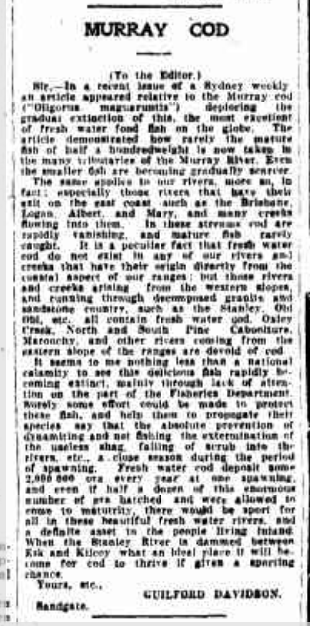
The Queenslander Illustrated Weekly – Brisbane. 1 Aug 1935
Comment:
In 1935 they were aware that the removal of trees had negative impacts on waterways & our fish.
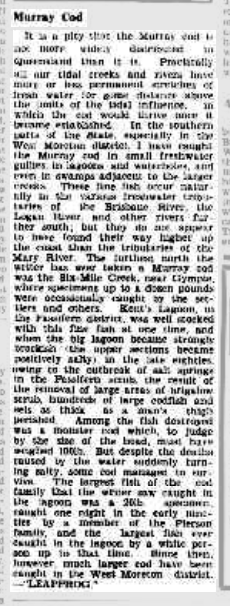
Tweed Daily.
24 March 1932
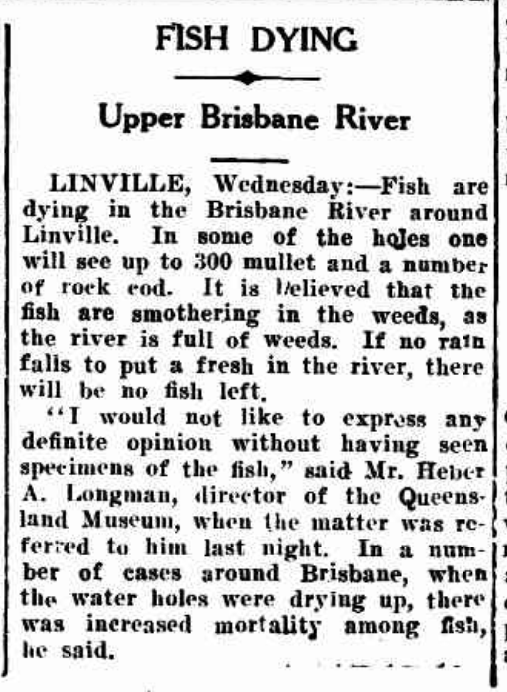
The Queenslander. 22 Nov 1879
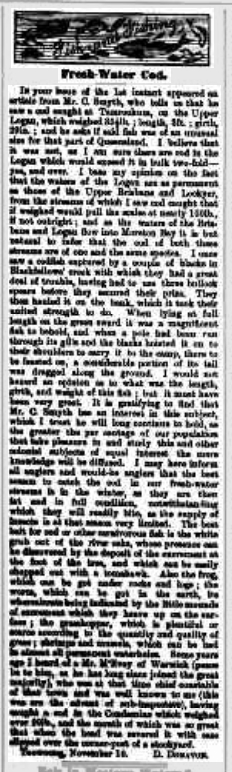
From John Oxley Journal. Page 36 – 39. 21 September 1824.
Describing Brisbane River Cod.
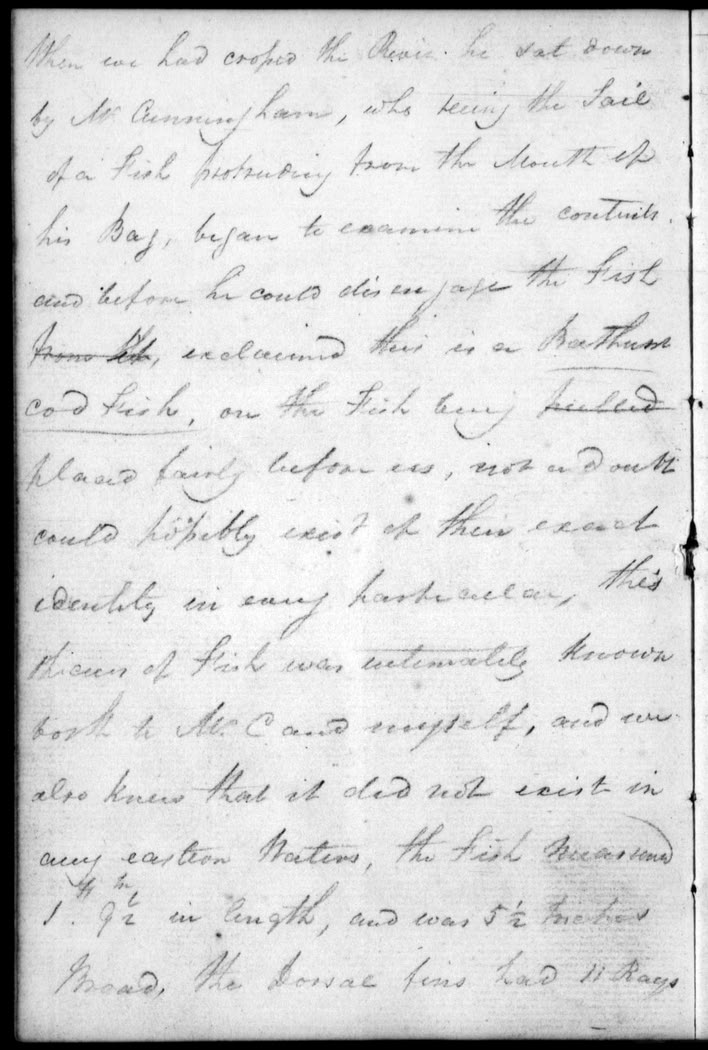
“On our route towards the Pine Ridge, we fell in with our old native who had been fishing when we crossed the river, he sat down by Mr Cunningham, who seeing the tail of a fish protruding from the mouth of his bag, began to examine the contents and before he could disengage the fish from the exclaimed this is a Bathurst cod fish, on the fish being pulled placed fairly before us, not a doubt could possibly exist of their exact identity in every particular, this species of fish was intimately known both to Mr. C and myself, and we also knew that it did not exist in any eastern Waters, the fish measured 1ft. 9 ½ ins in length , and was 5 ½ inches round. The dorsal fins had 11 rays the anal fin 3 rays towards the breast the pectoral fins were placed before the ventral fins, having ea 4 rays, the ventral fins were many rayed, and rounded the Central or tail fin the same. Four lines of gills, – With those that had once seen the fish of the Western Waters no doubt could remain, no other fish ever seen in any of the other fresh waters of the colony having the smallest resemblance to them; since we had been among the rapids several fish of very large size, some measuring more than 4 feet long had been seen by us all, in the deep pools under the steep banks, these we called the fresh water shark , having only n imperfect view of them though this dark shade of the waters, the larger sized fish of the Bathurst fish, do in outward form and at a distance somewhat resemble the shark.”
Brisbane River Cod Recovery Strategy
Brisbane River Cod Recovery Strategy
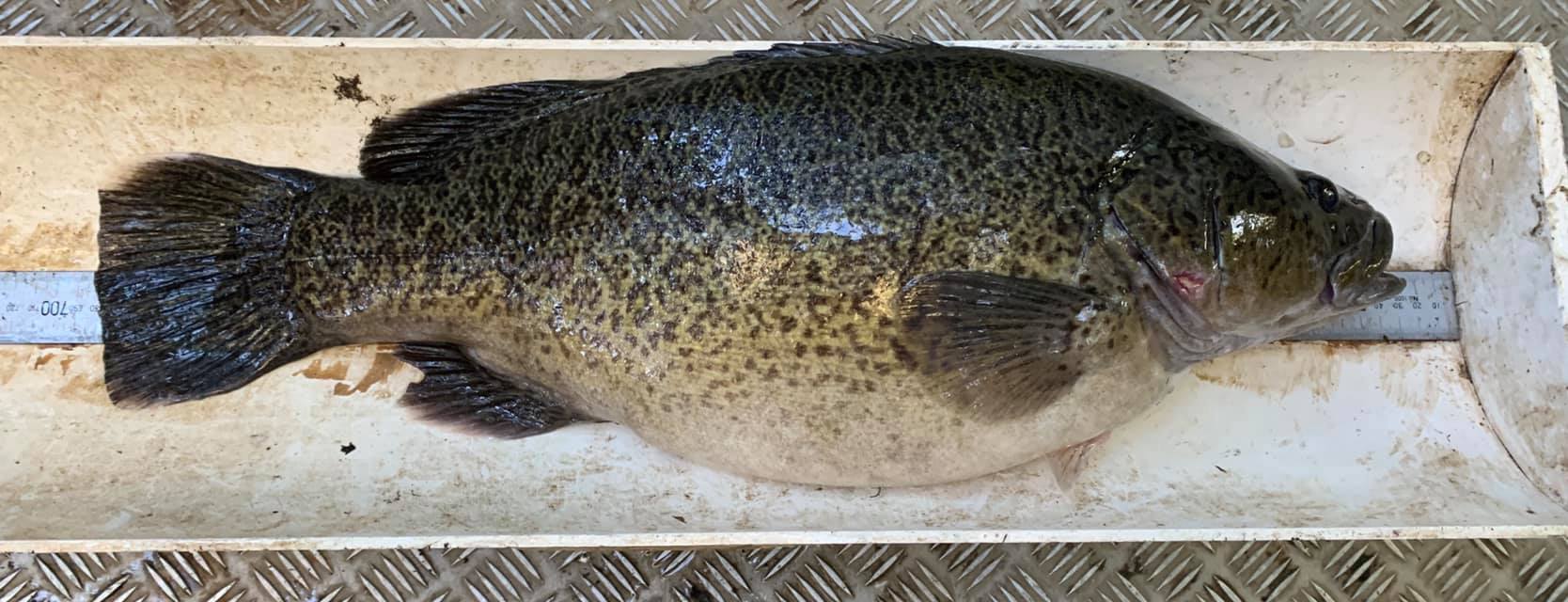
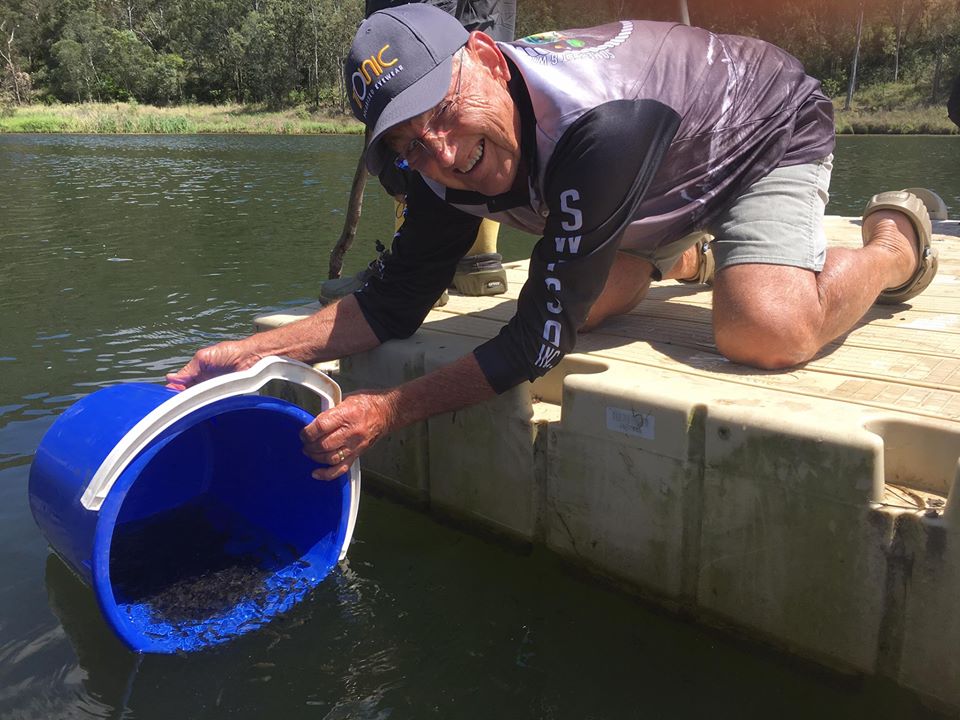
SWFSA stock Mary River Cod into several rivers & creeks in South East Queensland as part of the Brisbane River Cod Recovery Project.
Each year cod fingerlings are released into selected locations as part of a strategy to re-establish a self-sustaining population throughout the catchment.
SWFSA acknowledge CleanCo Qld, Ipswich City Council, Scenic Rim Regional Council, Somerset Regional Council, Somerset Regional Council & Resilient Rivers for their on-going support.
Assistance is also being provided through the jointly funded Commonwealth-State Disaster Recovery Funding Arrangements.
Together we can re-establish Cod to the Brisbane River Catchment.
Objective
To re-establish the self-sustaining presence of an apex predator Maccullochella cod species. in the Brisbane River catchment & tributaries.

General Principles
- A population of cod will not be re-established without the engagement with DAF, other stakeholders, land owners and the community.
- Community involvement & citizen science should be supported by appropriate levels of government.
- Existing community groups / networks should be used in preference to establishing new ones.
- The strategy should be kept simple, in lay person’s terms so that the community can understand.
This strategy should follow the principles of the existing Mary River Cod Research & Recovery Plan, focusing efforts on the Brisbane River & tributaries.
About Brisbane River Cod
Introduction
The Brisbane River cod was likely a unique form of Maccullochella cod that occurred naturally in the Brisbane River system, an east coast river system in south east Queensland. The Brisbane River Cod was known as the Bumgur (meaning blue cod) by the Jinibara people centred in the Kilcoy region and the junction of the Stanley and Brisbane Rivers. Their exact taxonomic status will never be known as there are no known specimens, even within the Qld Museum. Based on several genetic studies it is suspected that Brisbane River Cod were a species intermediate between eastern freshwater cod (Maccullochella ikei) of the Clarence and Richmond River systems in northern New South Wales and Mary River cod (Maccullochella mariensis) of the Mary River in central Queensland. (Wikipedia)
Recovery Strategy
With the possible exception of the upper Stanley River, there are clearly not enough cod present for recovery to occur in the foreseeable future without a committed restocking strategy. Stocking has created self-recruiting populations of both Mary River Cod in the Mary River, East Coast Cod in the Clarence River catchment and Murray Cod throughout the Murray / Darling system. A concerted effort is required for the cod in the Brisbane River catchment for recovery to occur.
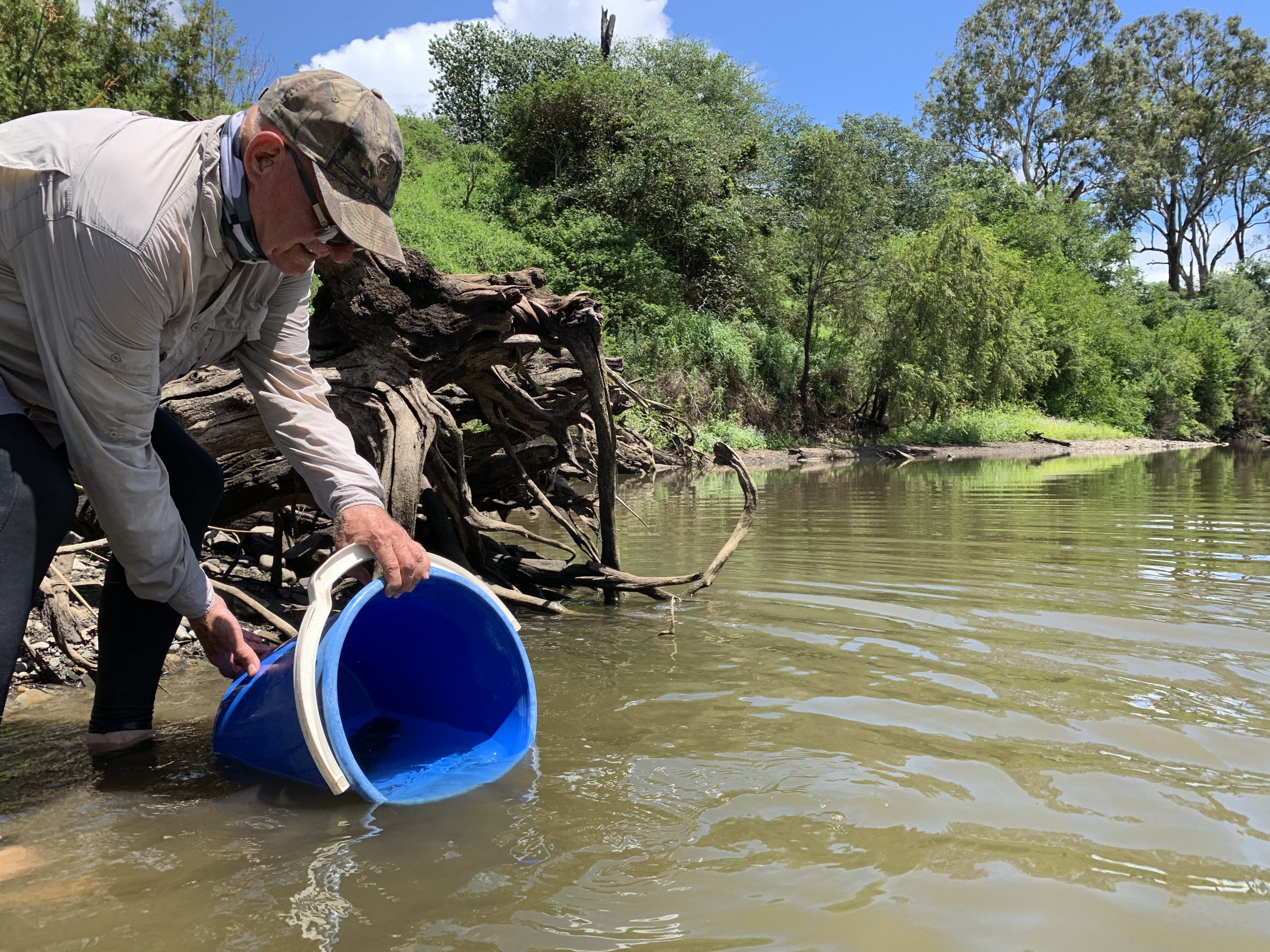
Restocking
The release of Mary River Cod at selected sites; approved by & under permit from Fisheries Queensland.
Each site is to have a maximum number of fingerlings for release each year of no more than 600 fish per hectare of surface water annually.
As each site will have a different carrying capacity or may prove to more or less suitable over time, the optimal stocking number may change over time for specific sites but is not to exceed 600 fingerlings / hectare / annum.
Land Owners
This strategy would not be possible without the engagement from many land owners throughout the catchments.
We thank you all for your on-going support to bring back this magnificent fish species.
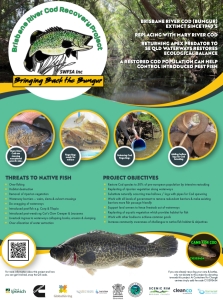
Cod Recovery Project Poster
Click to download
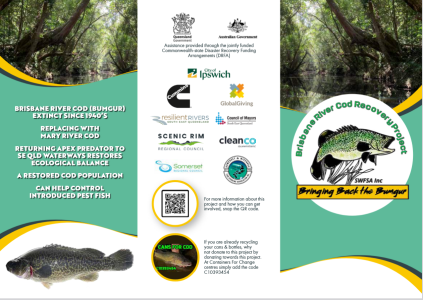
Cod Recovery Project Brochure
Click to download
Electrofishing Survey
In late 2023 / early 2024 with assistance is being provided through the jointly funded Commonwealth-State Disaster Recovery Funding Arrangements SWFSA engaged an independent Fisheries Biologist to undertake an electro-fishing study on how the Cod were going at this stage of the project.
Some encouraging results were found.
Read the full report at the link below.
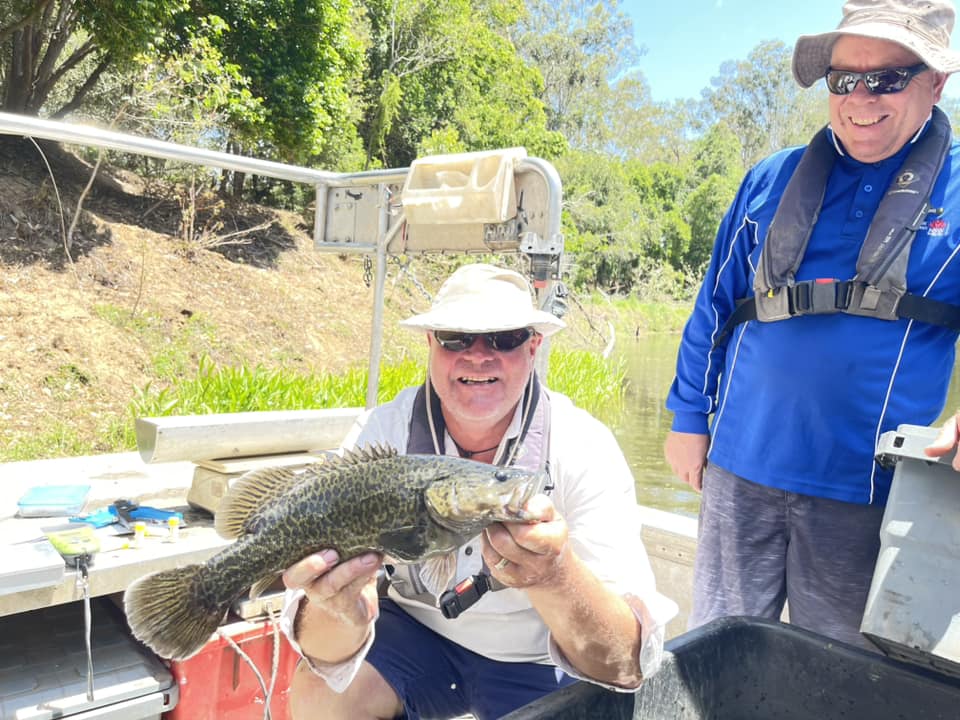
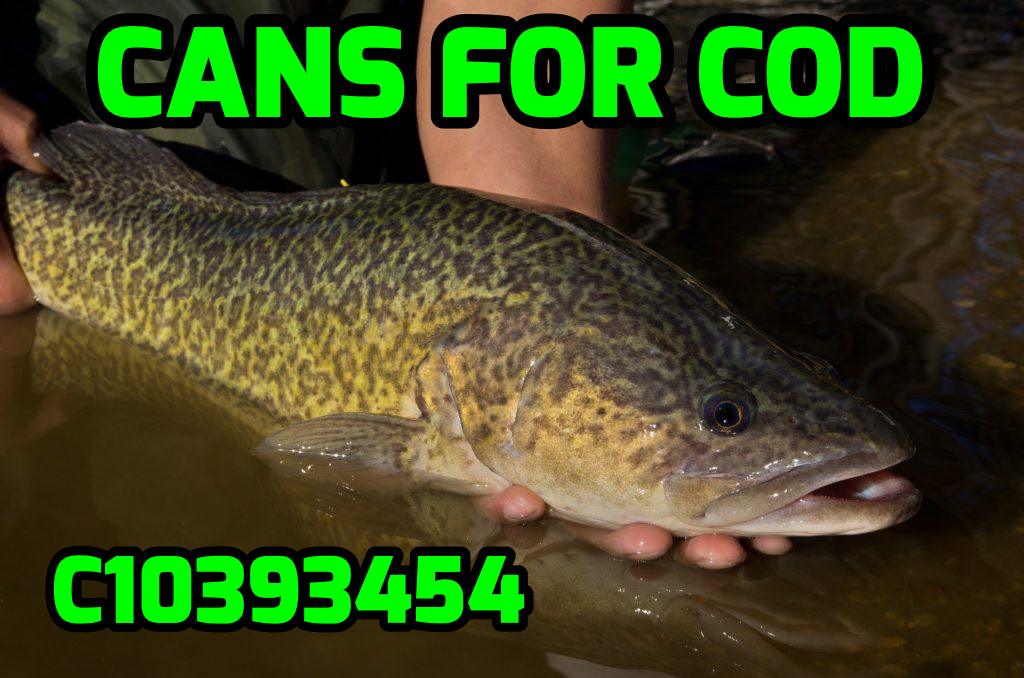
Cans For Cod
If You are doing the right thing by recycling your cans & bottles – why not go one better by nominating your cash to buying cod. Just quote our number C10393454
Every $5 buys 3 Cod to help restore the Cod in the Brisbane, Stanley & Bremer River catchments.
Threats to Cod Recovery

Over Fishing
Being an aggressive predator fish, cod are susceptible to capture by line fishing.
Lifting a large fish from the water for photographs can cause internal injuries which can kill a cod in the coming days.Any cod caught should be un-hooked in the water & immediately released.
Cod need to be protected from fishing during their spawning season in the form of fishing closures.

Waterway Barriers
Weirs and dams are built for flood mitigation & water storage, however these barriers impede the ability of many fish species need to migrate as part of their life cycle / reproduction.
Very few waterways barriers have adequate fishway.
Even culvert crossings over small creeks can block some native fish species ability to migrate for breeding.

Clearing of Riparian Vegetation
In-tact riparian vegetation is very important to waterways & fish. Natural riparian vegetation provides shade on the water helping to keep the water cooler. Trees roots help to hold river banks together and reduce erosion. Branches that may fall from over hanging trees create critical in-stream habitat for fish.
Livestock Ingress to Waterways
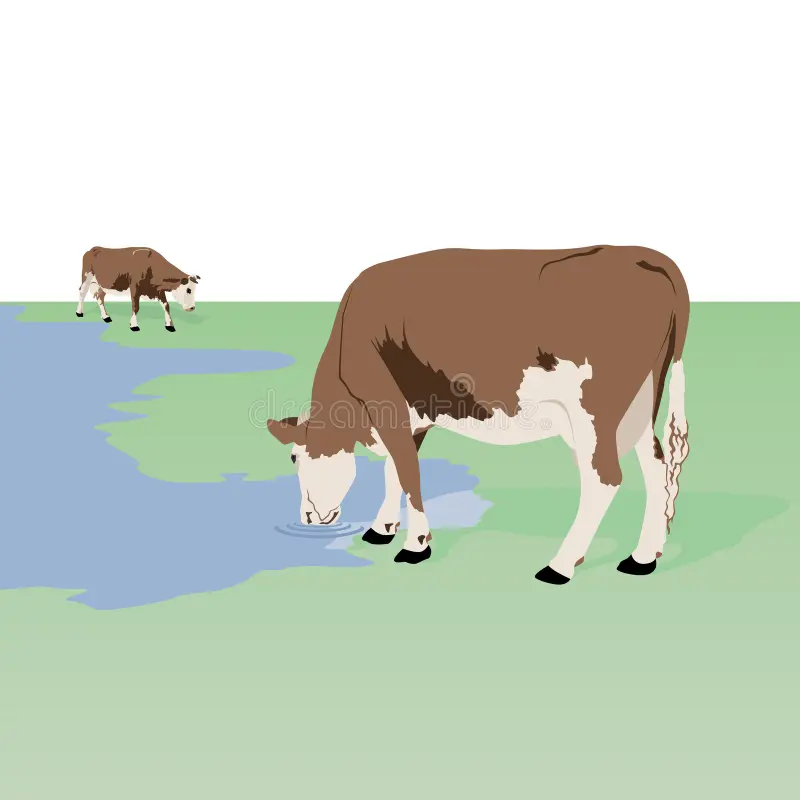
Livestock need to drink. However they tent to collapse river banks at watering points which increases erosion and sedimentation of the water.
Off-stream watering points for livestock are a better option for waterway health.
Project Partners / Supporters
This recovery project acknowledges the support from the Australian Government, Queensland Government, Cummins / Global Giving, City of Ipswich, Somerset Regional Council, Scenic Rim Regional Council, Resilient Rivers SE Qld, CleanCo Queensland and Healthy Land & Water.
Assistance is being provided through the jointly funded Commonwealth-State Disaster Recovery Funding Arrangements.









How You Can Help
There are several ways you can help us.

Become A Member
Attend meetings & other group activities. Membership is free.
Fingerling Releases
Come along to fingerling releases.

Donate
Make a donation to SWFSA to help us put more fish back in the water.

Monitoring
Enter fishing data into our monitoring app HERE>>>
Fishing Permit
Make sure your Stocked Impoundment Permit (SIPS) is up to date. Everyone 18 years of age & older is required to have one when fishing on Lakes Somerset & Wivenhoe. Get a Fishing Permit HERE>>>

Destroy Pest Fish
If you catch any Tilapia, Carp or Pearl Cichlids in any waterway please humanely kill them and place in bins around the lakes or bury them above the high water mark. Do not return them to the water, even if they’re dead.

Benefits of Fish Restocking
SWFSA stock several native fish species under a permit from Queensland Fisheries. The benefits of native fish restocking include:
Improved recreational fishing opportunities
Pest / noxious fish control
Species Recovery - Mary River Cod
Improved water quality
Frequently Asked Questions
Can I buy fingerlings from SWFSA?
No. We do not breed fish. We purchase native fingerlings in bulk from commercial fish hatcheries for release into local waterways.
Where & When do SWFSA meet?
SWFSA generally meet on the third Wednesday of each month at Fernvale. Check our social media for updates.
What does SWFSA membership cost?
Membership is free. You can join at any time.